ThE History of Abortion in Canada
Abortion has always existed, but its accessibility has varied profoundly throughout history.
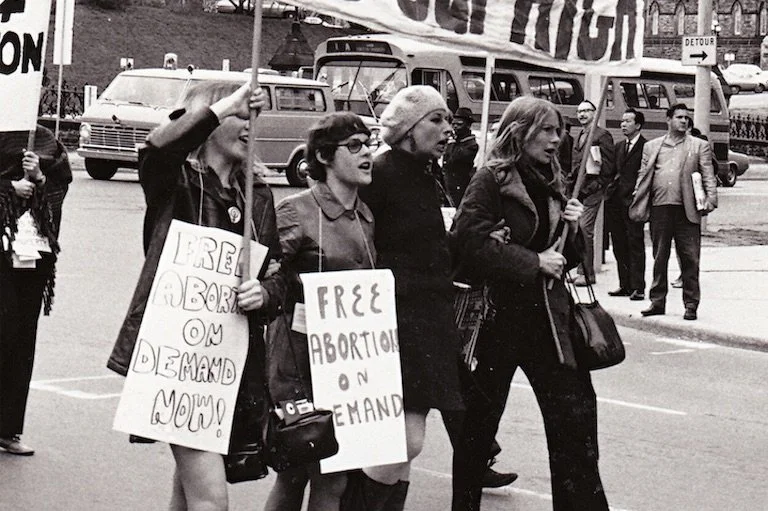
Protesters from the Abortion Caravan in 1970 (Grey, 2020)
Important Note
“Despite its prohibition under federal law, abortion continued to be performed by physicians and non-physicians alike. Access to (relatively) safe abortion depended on the patient’s ability to pay and the willingness of some physicians to provide the service on the “black market.” For many women, self-induced abortion and unsafe “back alley” procedures were the only available alternatives” (Burnett, 2019).
Since 1988, nearly 50 private members in the House of Commons have presented anti-abortion bills, signifying how far this battle is from being over (UBC CPD).
Abortion has always existed in traditional Indigenous knowledge. Land-based medicines have been used as abortifacents for time immemorial. The Fireweed Project’s Community Report is essential reading to understand how Indigenous worldviews may interact with the provision of abortion care.
Reflection
How would you like to protect yourself if you choose to provide abortion care? Consider how vocal you will be in your own promotion of abortion care servies. How might this impact people who are choosing abortion care and alternatively, how might this impact people who are uncomfortable with their midwives offering abortion care services?
-
Also known as Lord Ellenborough’s Act, this statute made performing or attempting to perform a post-quickening abortion a death penalty offence. This bill equated abortion to crimes such as shootings, stabbings, and poisonings (Courthouse Libraries BC, 2024).
-
This act removed the death penalty for abortion, replacing it with the punishments of transportation (exile) or imprisonment. It also revised the distinction between pre- and post-quickening abortions, making the procurement of an abortion at any gestation unlawful (Courthouse Libraries BC, 2024).
-
Also known as the Criminal Law Consolidation Act of 1861, this statute consolidated provisions from a number of earlier bills into a single Act. Notably, the punishment for procuring an abortion was updated to imprisonment for life. The statute also describes possible methods of illegal abortion, detailing “...whosoever, with intent to procure the miscarriage of any woman, whether she be or be not with child, shall unlawfully administer to her or cause to be taken by her any poison or other noxious thing, or shall unlawfully use any instrument or other means whatsoever with the like intent, shall be guilty of felony…” This included any attempt by the pregnant person themselves to end their pregnancy.
-
Enacted two years after Confederation, this statute consolidated and revised a number of pre-existing colonial and British laws. As a result, this was the first Canadian federal law criminalizing abortion. The punishment of life imprisonment was maintained. This Act remained largely unchanged until decriminalization in 1969, a full century later (Courthouse Libraries BC, 2024).
-
This law maintained abortion as a criminal offence, and outlined distinct punishments for the abortion provider and the abortion seeker. The physician or person providing the procedure was liable for life imprisonment, and the pregnant person was liable for up to two years in prison. Importantly, this law also prohibited the sale, distribution, and advertising of contraceptives (Courthouse Libraries BC, 2024).
-
This law arose out of the eugenics movement of the early 20th century, and legalized the forced or coerced sterilization of “unfit” persons. While this law applied to several vulnerable populations including racialized, poor, and disabled women, it primarily targeted Indigenous women and was common practice in Indian hospitals. While not directly pertaining to abortion, this law is integral to the history of reproductive justice. Furthermore, eugenics practices include coerced or forced abortions. Despite the Sexual Sterilization Act being revoked in 1973, the practice of forced or coerced sterilization of Indigenous peoples continues today, often occurring in the immediate postpartum (Stote, 2024) (Webb, 2024).
-
Legislation changed this year to decriminalize contraception and legalize abortion with specific criteria (for example, it had to be approved by a hospital committee). As a result of the imposed approval process, there was still limited access to legal abortions. In 1969, Dr. Henry Morgentaler also opened an illegal abortion clinic in Montreal, which was the first of its kind and allowed individuals to access abortions without the specific approval required by law at the time; he was later arrested for providing this care. (UBC CPD)
-
17 women from Vancouver organized and drove across Canada to Ottawa, collecting supporters along the way. In Ottawa, they shut down the House of Commons to protest Canada’s restrictive abortion laws. Despite the public efforts of the protesters, who even chained themselves to seats in the House of Commons galleries, abortion wasn’t addressed in the Charter of Rights and Freedoms until 1988. (Gray, 2020)
-
When it was first signed into law in 1982, the Charter of Rights and Freedoms gave a legal basis to challenge unconstitutional laws. Later, in 1988, Dr. Henry Morgentaler’s case was appealed in the Supreme Court, which ruled Canada’s abortion laws to be unconstitutional. In 1989, the Supreme Court case Tremblay v. Daigle ruled that somebody’s sexual partner doesn’t have legal authority to determine whether that person has an abortion. After 1988, abortion laws were placed under provincial jurisdiction, which resulted in some provinces like Quebec hosting many abortion services and others like New Brunswick to become more restrictive (UBC CPD).
-
In British Columbia, safe access zones/bubble zones were introduced, which means that anti-choice expression was prohibited within 50m of an abortion clinic or hospital. This law was implemented in response to the attempted murder of Dr. Garson Romalis, who was an abortion care provider. Other provinces such as Alberta, Ontario, Quebec, Nova Scotia, and Newfoundland & Labrador have since introduced their own laws about bubble zones (UBC CPD).
-
Health Canada approved Mifepristone, which increased access to medication abortions nationwide. In 2019, Mife/Miso was approved for national funding and is covered by provincial health care plans (UBC CPD).
Click on the play button below to listen to the CBC Documentary by Karin Wells about the Abortion Caravan

Reflection
What surprises you about the history of abortion in Canada, if anything?
What are some ways you can incorporate this knowledge into your practice?